
JCU Singapore

Joseph Angelo
- Senior Manager Laboratory
- joseph.angelo@jcu.edu.au

Lucy Tan
- Associate Professor Clinical Psychology
- lucy.tan@jcu.edu.au
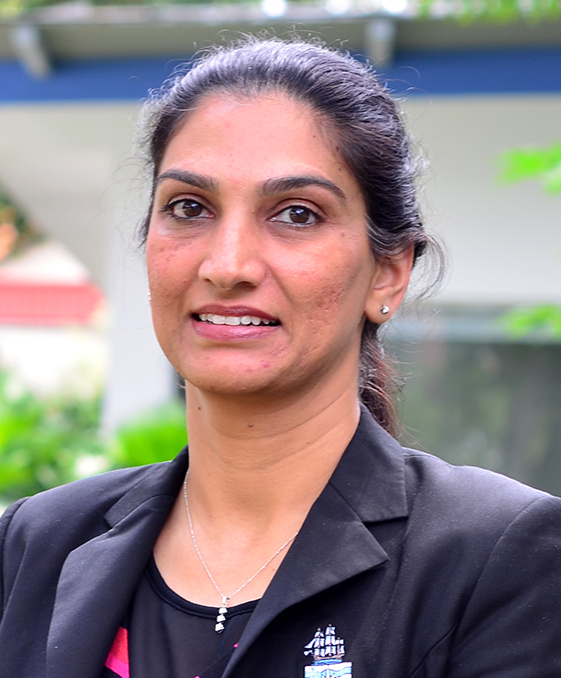
Divjyot Kaur
- Senior Lecturer Psychology
- divjyot.kaur@jcu.edu.au

Pengji Wang
- Acting Academic Head JCU Singapore Business School / Associate Professor Business
- pengji.wang@jcu.edu.au

Zilmiyah Kamble
- Senior Lecturer Hospitality & Tourism Management
- zilmiyah.kamble@jcu.edu.au

Eddy Ng
- Professor Organisational Behaviour
- eddy.ng@jcu.edu.au

Xueyan Shen
- Associate Professor
- xueyan.shen@jcu.edu.au

Michael Joyce
- Senior Learning Specialist
- michael.joyce@jcu.edu.au

Adrian Kuah
- Professor
- adrian.kuah@jcu.edu.au

Peter Chew
- Associate Professor
- peter.chew@jcu.edu.au
Life history and ecology analysis of the whitespotted whipray and sharpnose whipray: assessing vulnerability to fisheries.
The whitespotted whipray and sharpnose whipray (Endangered), are the preferred and most imported stingray species into Singapore for BBQ stingray. Understanding how vulnerable a species is to exploitation in relation to their ‘life history’ enables the creation of species-suitable fisheries management plans. A species’ life-history will answer questions such as: when do they reach maturity? How long do they live for? How many young do they have? While their ecology will give insight to their diet and habitat use. This information will enable understanding of their vulnerability, and help inform fisheries management and conservation throughout their range.
¬¬Mediating effect of capital flow between inter-state sanctions and economic growth: How successful is sanction in achieving its goals?
Asian Finance Annual Conference provides an open platform for finance scholars worldwide to present their recent research and exchange ideas on new developments in finance research. The majority of the sessions will include papers selected through open competition. The papers will be reviewed by a committee of established researchers. I will meet with journal editors of The Pacific Basin Finance Journal, the conference journal, to get an idea of how to increase my chance of getting my paper published in the Journal.
I am looking forward to seeking feedback for the paper that I am going to present in the conference.
Mind your own business, you are a pest! A study on workplace nosiness and its impact on employees
Workplace nosiness has been increasingly recognized as a detrimental factor affecting employee mental health and productivity. Studies have shown that intrusive behaviors lead to higher stress levels, decreased job satisfaction, and lower productivity. Despite this recognition, there is a lack of comprehensive research that systematically examines the antecedents, types, and impacts of workplace nosiness across different organizational contexts. This study aims to fill this gap by providing a detailed analysis of workplace nosiness and its effects. The research will contribute to the existing body of knowledge by identifying specific behaviors and practices that constitute workplace nosiness, demonstrating the direct and indirect impacts of nosiness on key employee outcomes, and offering practical recommendations for managers and organizations to address and reduce nosiness.
Academy of Management (AOM) Meeting 2024, Chicago
The Annual Academy of Management (AOM) Meeting is the world's premier event and the largest gathering of 10,000+ management and organization scholars annually. There are 3 JCUS authors coming together in crafting this paper over the last 2 years. The work falls under Organization Development and Change (ODC) Division at the Academy and has been accepted for presentation. It would be a wonderful opportunity to meet the 800 scholars and editors in the ODC at this meeting. Having partake in the conference regularly, I would have the opportunity to catch up with colleagues and meet journal editors to impress upon the community and editors on the importance of our work,
Understanding employees’ perspectives on the usage of Mandai Animal Care Application
In today’s work environment which is defined by digital transformation, the convergence of technology and productivity has brought about a paradigm shift in how employees manage their daily work responsibilities (Singh et al., 2020). Once synonymous with personal convenience, mobile applications have emerged as indispensable tools in the professional landscape. As organizations strive to adapt to an ever-evolving business environment, mobile application development for work has become a focal point of innovation and efficiency (Leong et al., 2020). Besides, the growing popularity of mobile technology has ushered in a new era where work knows no bounds. Besides, employees carry their work with them, securely and conveniently, within the confines of their smartphones and tablets (Pillai et al., 2021). This transformation is not about portability but signifies a fundamental shift in how work is organized, executed, and experienced. Within this context, our research examines the usage experience of mobile work applications and the critical factors that encourage mobile application adoption.
The purpose of this project is twofold.
First, we examine the intricacies of the usage experience of a work mobile application. We would target to answer questions like - What makes these apps effective tools for productivity? How do they influence the work-life balance of employees? Are there specific design features that contribute to a more seamless user experience?
Second, our project seeks to discover the factors driving the adoption of work mobile applications. Understanding what motivates individuals and organizations to embrace these tools is pivotal for developers, businesses, and policymakers. These factors could include usability, security, cost-effectiveness, and organizational culture.
Our project adopts a two-studies approach to accomplish these objectives, combining interviews and user surveys, as follows:
(a) Study 1 identifies the perspectives on employees’ usage experience and factors driving the adoption or non-adoption of the work mobile application.
(b) Study 2 involves the deployment of the survey to measure the usage experience and draw relationships with micro-, meso- and macro-outcomes
Understanding employees’ perspectives on the usage of Mandai Animal Care Application
In today’s work environment which is defined by digital transformation, the convergence of technology and productivity has brought about a paradigm shift in how employees manage their daily work responsibilities (Singh et al., 2020). Once synonymous with personal convenience, mobile applications have emerged as indispensable tools in the professional landscape. As organizations strive to adapt to an ever-evolving business environment, mobile application development for work has become a focal point of innovation and efficiency (Leong et al., 2020). Besides, the growing popularity of mobile technology has ushered in a new era where work knows no bounds. Besides, employees carry their work with them, securely and conveniently, within the confines of their smartphones and tablets (Pillai et al., 2021). This transformation is not about portability but signifies a fundamental shift in how work is organized, executed, and experienced. Within this context, our research examines the usage experience of mobile work applications and the critical factors that encourage mobile application adoption.
The purpose of this project is twofold.
First, we examine the intricacies of the usage experience of a work mobile application. We would target to answer questions like - What makes these apps effective tools for productivity? How do they influence the work-life balance of employees? Are there specific design features that contribute to a more seamless user experience?
Second, our project seeks to discover the factors driving the adoption of work mobile applications. Understanding what motivates individuals and organizations to embrace these tools is pivotal for developers, businesses, and policymakers. These factors could include usability, security, cost-effectiveness, and organizational culture.
Our project adopts a two-studies approach to accomplish these objectives, combining interviews and user surveys, as follows:
(a) Study 1 identifies the perspectives on employees’ usage experience and factors driving the adoption or non-adoption of the work mobile application.
(b) Study 2 involves the deployment of the survey to measure the usage experience and draw relationships with micro-, meso- and macro-outcomes
Segmentation of Panoramic Dental Radiograph Using AI: AU-Net Based Approach
Dental radiographs, particularly panoramic X-rays, are critical for diagnosing and planning treatments for various dental conditions. Traditional manual analysis of these images is labor-intensive and prone to errors. Artificial Intelligence (AI), especially deep learning techniques, has transformed image segmentation tasks. This research investigates the application and comparative performance of four advanced AI-driven deep learning
models—U-Net, TransUNet, V-Net, and UNet++—for segmenting dental structures in panoramic X-rays.
What Attracts Domestic and International Travelers to Visit Museums in Phuket
This project is to understand the factors in attracting local and international tourists to visit Phuket museums
Early Child Health Intervention Using Breathing Sound
Early Child Health Intervention Using Breathing Sound. Insu Song and Joachim Diederich of the James Cook University in Singapore propose a cell phone-based system for collecting and analyzing time location-tagged children's crying and breathing sounds to detect respiratory infections. This system provides treatment information for parents and generates public health data regarding the spread of infectious diseases.
Paraphrase or plagiarism? Exploring EAP students’ use of source material in a transnational university context
The relationship between paraphrase and plagiarism is complex and has been the subject of multiple research studies. However, recent advances in Generative AI (GenAI) have disrupted the standard practices of academic writing and established a renewed focus on how learners acquire skills in English writing in a higher education context. To understand the future of academic writing in the technological era, further investigation of how and why students choose to paraphrase and engage with source material is needed to guide best practices in instruction, policy, and research. This exploratory study seeks to fill this gap and provide insight into the choices English as a Second Language (ESL) student writers make in an English for Academic Purposes (EAP) context. Using a text-based interview method and custom-designed academic writing task, we examine how students engage with and make decisions about using source material. Results reveal that participants focus more on sentence-level approaches to paraphrasing and mechanistic methods of language transformation. This is partly motivated by prior learning experiences but may also be related to adopting a risk-averse approach to language use to avoid accusations of plagiarism. Furthermore, our participants expressed a low level of confidence in the ability of new technological tools to help learners acquire skills in English writing. These findings suggest that there is a need for further research exploring policies to enable experimentation in EAP programs, as well as exploring acceptance and belief in new technologies’ ability to support paraphrasing and source use. See https://doi.org/10.37074/jalt.2024.7.2.11