
Tropical Water & Ecosystems
Scott Morrissey
- Research Officer
- scott.morrissey@jcu.edu.au
Tim Smith
- Senior Research Officer
- tim.smith2@jcu.edu.au
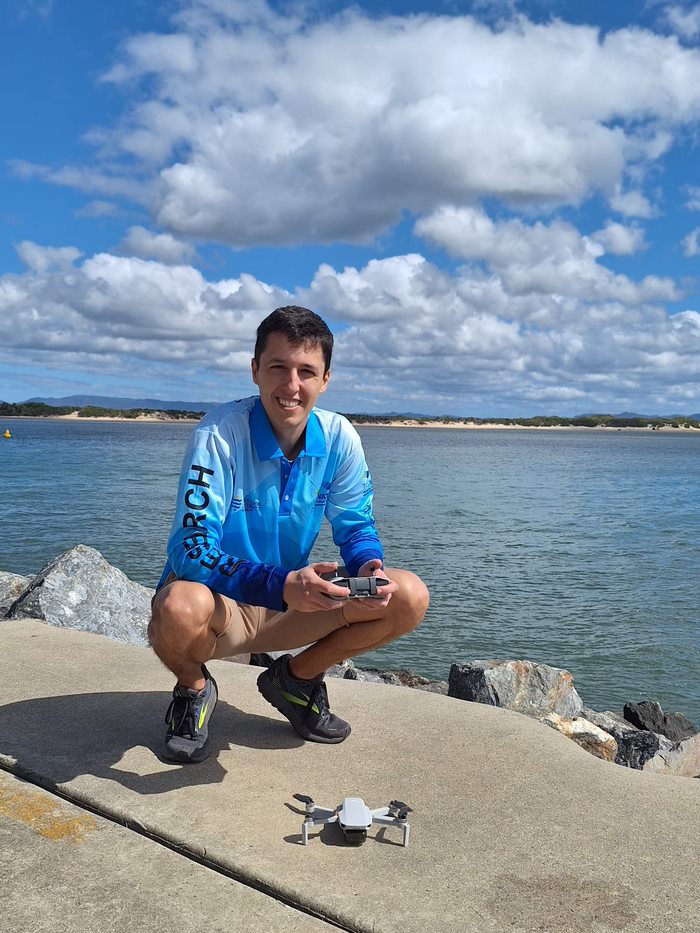
Alejandro Navarro Otero
- Casual Research Worker
- alejandro.navarrootero@jcu.edu.au
Jack Koci
- Principal Research Officer
- jack.koci1@jcu.edu.au
Sarah McDonald
- Senior Research Officer
- sarah.mcdonald@jcu.edu.au
Emily Webster
- Research Officer
- emily.webster1@jcu.edu.au

Abbi Scott
- Senior Research Officer
- abbi.scott1@jcu.edu.au

Catherine Collier
- Principal Research Officer
- catherine.collier@jcu.edu.au

Rob Coles
- Principal Research Scientist
- rob.coles@jcu.edu.au

Aaron Davis
- Principal Research Officer
- aaron.davis@jcu.edu.au
Operation Lumut (seagrass) Rescue: taking action to restore and monitor seagrass in the Cocos (Keeling) Islands Marine Park (Old ID 29027)
This project brings together local knowledge and ecological expertise to develop a robust, restoration program for seagrass habitats at the Cocos Keeling Island’s southern atoll. Specifically, this project will work to improve our understanding of the natural dynamics and resilience of local seagrass habitats and the pressures acting on them to limit natural recovery, and use this information to identify, trial and evaluate restoration activities to drive seagrass recovery.
Engaging with farmers and demonstrating water quality outcomes to create confidence in on-farm decision-making ("Project 25") (Old ID 22544)
Recent global experiences suggest that spatially identifying and prioritizing landscape ‘hotspots’ of pollutant generation for management intervention, and small catchment-scale water quality monitoring in collaboration with landholders linking water quality with specific management practices, are among the most promising strategies for reducing water quality pollution. This project will combine recent hotspot identification in GBR sugarcane catchment of the Russel/Mulgrave with targeted cane farmer interaction activities (related to sub-catchment and localized monitoring activities), focusing on emerging monitoring technologies (real-time water quality monitoring) to link farmer on-farm practices with feedback from sub-catchment water quality measurements. The use of both scientific and citizen science monitoring approaches will deliver robust feedback loops to enable farmers to directly link their activities with water quality conditions. The project will focus on on-farm practice improvements in highest priority catchments to achieve maximum benefits to GBR health from catchment management actions.
Deriving ecologically relevant targets to meet desired ecosystem condition for the Great Barrier Reef: a case study for seagrass meadows in the Burdekin region (Old ID 26473)
This project will derive ecologically relevant targets (ERTs) for water quality and sediment loads for the Burdekin basin and provide the ecological targets required to revise ERTs across the GBR by: 1) defining seagrass desired state targets for the GBR: 2) calculating water quality guidelines (light); and 3) calculating ERTs for te3rrestrially sourced sediment loads, using Cleveland Bay as a case study. Historical and new data collections will be compiled and used to derive ERTs via statistical models and eReefs (RECOM), and the seagrass sub-model in eReefs will be used to test ERTs.
Characterising Mary River flood sediment deposited in Hervey Bay. (Old ID 27627)
Analysis of recently deposited sediments in seagrass meadows offshore from the Mary River.
Fire and Environmental Change in Northern Australia during the Late Holocene (Old ID 23372)
This project addresses the lack of palaeoenvironmental and palaeofire records available for northern Australia. I will analyse both micro-(<125µm) and macroscopic (>125µm) charcoal from sediment cores collected from lacustrine sites in Cape York and Arnhem Land. I will also analyse modern charcoal collected in fire traps placed during fieldwork to create a modern analogue. Collaboration with AINSE/ANSTO will result in a high-resolution chronology for each site, with implications for the wider region.
2017 Eastern Cape York Shoreline Environmental Surveys (Old ID 23402)
The aim of this project is to conduct shoreline surveys along Australia's east coast from Cairns to Cape York during 2017. These works will involve a number of activities focused on monitoring the character and condition of shoreline habitats and estuaries, as well as partnering with local indigenous custodians, filming in aerial surveys plus field investigations and mapping. This work compliments extent mapping undertaken by the Qld Herbarium in that both extent and condition are required to assess the status of mangrove ecosystems. This project will evaluate and combine spatial and condition monitoring coupled with identification of drivers of change for all key instances of change.
Keeping our chemicals in their place - in the field (Old ID 24738)
The study assesses on-farm management practices in relation to minimising off-farm losses of pesticides in the Australian sugar industry. The study will involve a series of integrated short-term and long-term paddock-scale studies of pesticide movement in runoff to identify best management practices for pesticide management.
Implementation Plan for Dugong Population Surveillance in the Southern Great Barrier Reef. (Old ID 27614)
There are evidences of dugongs declining in the southern Great Barrier Reef (sGBR) and monitoring is overdue. New technologies such as aerial imagery could enhance the survey of dugongs in the sGBR but an implementation plan needs to be developed to review the latest advances in survey technology as well as knowledge gaps, to better advise on the most adequate way to survey dugongs in the sGBR in the next surveys.
Applying Indigenous and western science knowledges to inform the sustainable management of a dugong and seagrass hotspot in the Girringun TUMRA (Old ID 27853)
Girringun Aboriginal Corporation (GAC) are deeply concerned about potential threats and reduced resilience for the coastal environment. This project will address knowledge gaps around dugongs and seagrasses that are core to Traditional Owner’s cultural identity and traditional values; critical to the cultural, natural, socio-economic values of the Girringun Traditional Use of Marine Resources Agreement (TUMRA) and Indigenous Protected Area, the Great Barrier Reef World Heritage Area and the Hinchinbrook Island Dugong Protection Area. This project is a collaboration between GAC, seagrass and dugong experts from James Cook University, and Charles Darwin University to heal the Reef.
Mapping South East Arnhem Land Sea Country - Intertidal (Old ID 27885)
Understanding the location and extent of ecological and cultural values in Sea Country is necessary to support the aspirations of South East Arnhem Land (SEAL) people and further their connection with Sea Country through sustainable resource management. The proposed SEAL Sea Country IPA has high biodiversity values, including extensive habitat for large foraging populations of dugong and turtles which depend on healthy seagrass. Historical seagrass data, dugong aerial surveys (2019), recent surveys in adjacent Marra Sea Country (2021) and the Yanyuwa IPA (2021-22) indicate that extensive areas of seagrass habitat also occur in the SEAL IPA. However, there are no recent maps of seagrass habitat in the IPA. This project will assist the Aboriginal Traditional Owners to protect, maintain and sustainably manage Aboriginal land/ and sea country within the proposed SEAL Marine Indigenous Protected Area by providing base line bilingual maps, GIS and report of seagrass and other benthic habitats.
Coral reef fish smell leaves to find island homes
- 2008
- Royal Society Publishing
- Researchers:Maya Srinivasan
Coral-dwelling fishes resistant to bleaching but not to mortality of host corals
- 2009
- Inter-Research
- Researchers:Maya Srinivasan
Increased accuracy of batch fecundity estimates using oocyte stage ratios in Plectropomus leopardus
- 2009
- Wiley-Blackwell
- Researchers:Alexandra Carter
Start Date:
01 Jan 2009
End Date:
01 Jan 2026
Start Date:
01 Jan 2009
End Date:
01 Jan 2030
Start Date:
01 Jan 2014
End Date:
01 Jan 2030
Start Date:
01 Jan 2021
End Date:
01 Jan 2025
Start Date:
01 Jan 1981
End Date:
01 Jan 1984
Start Date:
01 Jan 1986
End Date:
01 Jan 1988
Start Date:
01 Jan 1973
End Date:
01 Jan 1973
Start Date:
01 Jan 2024
Start Date:
01 Jan 2022
End Date:
01 Jan 2023
Title:
Conference co-chair
Start Date:
01 Jan 2023
End Date:
01 Jan 2023