
Tropical Futures Institute Limited

Maura Carrai
- Senior Research Fellow - Aquaculture Molecular Health
- maura.carrai@jcu.edu.au
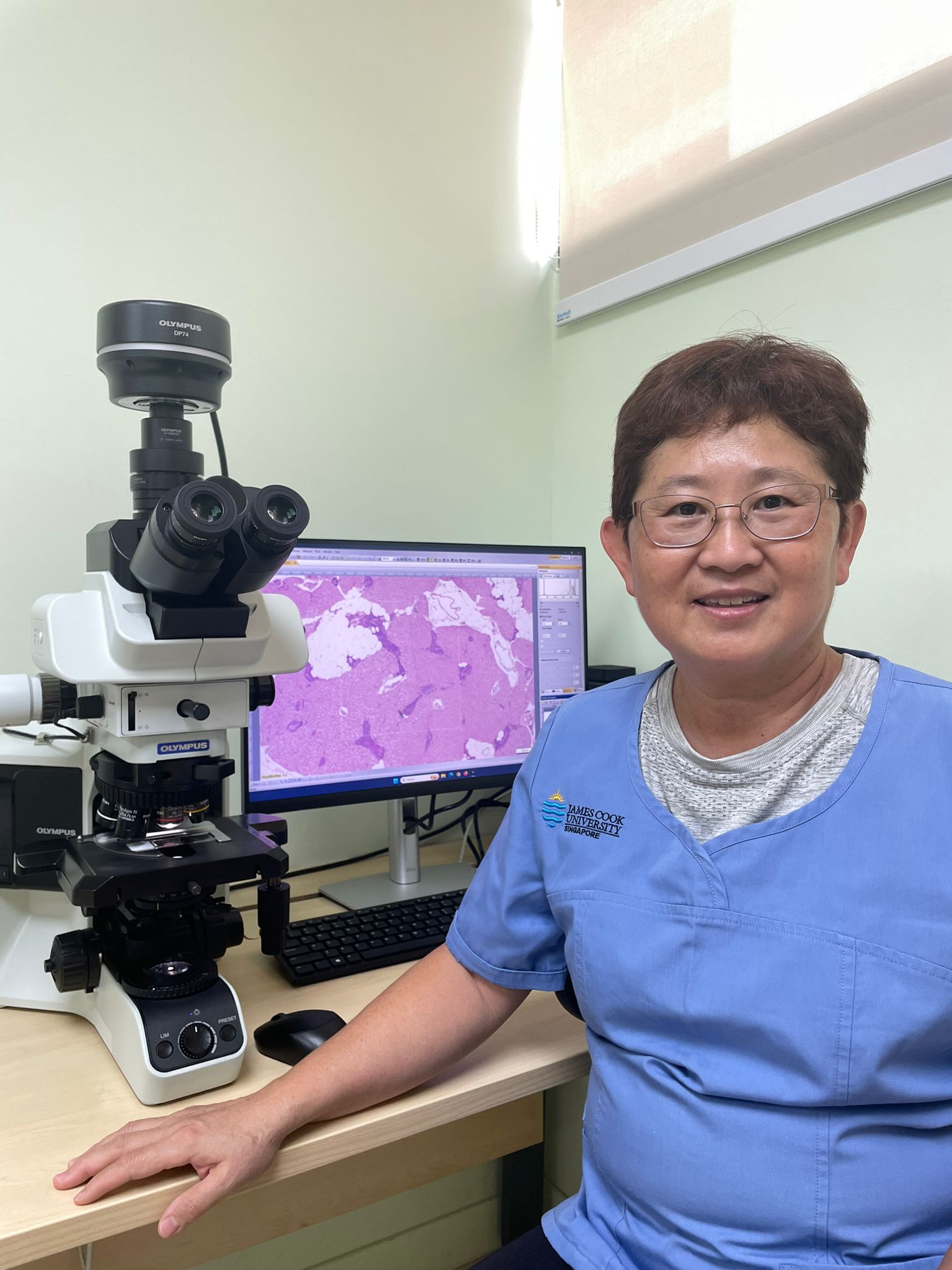
Susan Kueh
- Associate Professor (Aquatic Animal Health)
- susan.kueh@jcu.edu.au

Joseph Angelo
- Senior Manager Laboratory
- joseph.angelo@jcu.edu.au

Xueyan Shen
- Associate Professor
- xueyan.shen@jcu.edu.au

Jose Domingos
- Professor/Principal Research Fellow Aquaculture and Deputy Director TFI
- jose.domingos1@jcu.edu.au

Thimo Ruethers
- Senior Research Fellow Human Health & Aging
- thimo.ruethers@jcu.edu.au
James Loh
- Associate Professor / Principal Research Fellow Aquaculture
- james.loh@jcu.edu.au
PROVISION OF TRAINING SERVICES FOR AQUACULTURE FARMS FOR TWO YEARS
James Loh
01 Sep 2025 - 31 Dec 2027
The Singapore Food Agency (or “SFA”) is inviting suppliers for proposals on the provision of training services to aquaculture (i.e. food fish) farms in Singapore to enhance farmers’ capability and skills on farm management and good aquaculture practices. To contribute to Singapore’s Aquaculture Plan, farms will need guidance to mitigate the increased risk of diseases as they intensify production on limited space. The services shall be provided over a period of 2 years.
Optimizing Poultry Meal and Gelatin Concentrations in Feed for Scylla serrata: Effects on Growth, Digestibility, Survival, and Pellet Performance
Susan Kueh
01 Oct 2025 - 30 Sep 2027
This research investigates the effects of varying gelatin and poultry meal concentrations in feed formulations for Scylla serrata (mud crab) through two distinct trials aimed at enhancing pellet performance, growth, digestibility, and survival in aquaculture settings. In Trial 1, the focus is on evaluating gelatin concentrations of 8%, 12%, and 16% to determine their impact on pellet properties and palatability. The diets are carefully formulated to be isonitrogenous (approximately 43% crude protein) and isolipidic (approximately 15% crude lipid), incorporating 9% poultry meal while adjusting soybean meal to balance the gelatin variations. Feed preparation involves grinding dry ingredients—such as fishmeal, soybean meal, krill meal, poultry meal, and wheat flour—to a particle size of less than 500 μm, followed by thorough mixing. Gelatin is dissolved in warm water (50–60°C), combined with the dry mix along with fish and squid oils, extruded through a 10-mm die, and dried to achieve approximately 10% moisture content. The experimental design comprises nine pellet batches (three diets, each with three replicates), which are assessed for dry hardness using breaking force or a subjective scale, softness after rehydration in saline water through water absorption and compression force measurements, storage efficiency over eight weeks by monitoring lipid oxidation (peroxide value) and physical integrity, and palatability based on feed consumption rates observed in nine crabs. Trial 2 shifts the focus to poultry meal concentrations of 0%, 5%, 9%, 15%, and 20%, utilizing diets with 12% gelatin and chromic oxide as a digestibility marker. These diets are formulated by progressively replacing soybean meal with poultry meal to maintain nutrient consistency. The setup involves 150 adult crabs (100–200 g), each housed individually in PVC containers equipped with shelters to prevent cannibalism and fed twice daily at 5% body weight for eight weeks under controlled environmental conditions (25 ppt salinity, 28°C, pH 7.5–8.5, dissolved oxygen >5 mg/L). Data collection encompasses growth metrics including weight gain, specific growth rate, and carapace dimensions, apparent digestibility determined through fecal chromic oxide analysis, survival rates, and, if feasible, additional parameters such as digestive enzyme activities and blood biochemistry. Statistical analysis for both trials employ one-way ANOVA or Kruskal-Wallis tests, with post-hoc analysis conducted at a significance level of p < 0.05 to evaluate differences across treatments. This study aims to develop optimized, sustainable feed formulations to support mud crab aquaculture effectively.
Optimizing Poultry Meal and Gelatin Concentrations in Feed for Scylla serrata: Effects on Growth, Digestibility, Survival, and Pellet Performance
James Loh
01 Oct 2025 - 30 Sep 2027
This research investigates the effects of varying gelatin and poultry meal concentrations in feed formulations for Scylla serrata (mud crab) through two distinct trials aimed at enhancing pellet performance, growth, digestibility, and survival in aquaculture settings. In Trial 1, the focus is on evaluating gelatin concentrations of 8%, 12%, and 16% to determine their impact on pellet properties and palatability. The diets are carefully formulated to be isonitrogenous (approximately 43% crude protein) and isolipidic (approximately 15% crude lipid), incorporating 9% poultry meal while adjusting soybean meal to balance the gelatin variations. Feed preparation involves grinding dry ingredients—such as fishmeal, soybean meal, krill meal, poultry meal, and wheat flour—to a particle size of less than 500 μm, followed by thorough mixing. Gelatin is dissolved in warm water (50–60°C), combined with the dry mix along with fish and squid oils, extruded through a 10-mm die, and dried to achieve approximately 10% moisture content. The experimental design comprises nine pellet batches (three diets, each with three replicates), which are assessed for dry hardness using breaking force or a subjective scale, softness after rehydration in saline water through water absorption and compression force measurements, storage efficiency over eight weeks by monitoring lipid oxidation (peroxide value) and physical integrity, and palatability based on feed consumption rates observed in nine crabs. Trial 2 shifts the focus to poultry meal concentrations of 0%, 5%, 9%, 15%, and 20%, utilizing diets with 12% gelatin and chromic oxide as a digestibility marker. These diets are formulated by progressively replacing soybean meal with poultry meal to maintain nutrient consistency. The setup involves 150 adult crabs (100–200 g), each housed individually in PVC containers equipped with shelters to prevent cannibalism and fed twice daily at 5% body weight for eight weeks under controlled environmental conditions (25 ppt salinity, 28°C, pH 7.5–8.5, dissolved oxygen >5 mg/L). Data collection encompasses growth metrics including weight gain, specific growth rate, and carapace dimensions, apparent digestibility determined through fecal chromic oxide analysis, survival rates, and, if feasible, additional parameters such as digestive enzyme activities and blood biochemistry. Statistical analysis for both trials employ one-way ANOVA or Kruskal-Wallis tests, with post-hoc analysis conducted at a significance level of p < 0.05 to evaluate differences across treatments. This study aims to develop optimized, sustainable feed formulations to support mud crab aquaculture effectively.
Supply of training services for half day courses on 1)Fish Stock Handling and 2) Aquaculture Disease Prevention and Response
Susan Kueh
01 May 2023 - 31 Dec 2023
This ITQ invites training providers to submit proposals to conduct training courses for aquaculture farmers. To contribute to Singapore’s “30 by 30” local production goal, farmers will need guidance to mitigate the increased risk of diseases as they intensify production on limited space.
Air nanobubbles enhance nitrifying bacteria activity in marine RAS
Susan Kueh
27 Oct 2025 - 28 Nov 2025
This publication stems from the findings in two special topic projects within the JCU Science Aquaculture major degree, on use of nanobubbles in marine recirculating aquaculture systems stocked with tilapia, red snapper and barramundi.
The two students have since graduated from JCUS, and completed or currently pursuing an MSc. Afifah Sean (1st author) carried out the microbiological assessment of the marine RAS during the 6 week experimental trial, using a flow cytometer on loan from Sysmex Asia Pacific PL. Tzer Shyun Lim (2nd author) managed the marine RAS injected with nanobubbles and the control system without nanobubbles, and determined the growth performance of fish stocked in these systems. The nanobubble delivery system was on loan from AquaPro Solutions PL.
Afifah's project was supervised by Susan Gibson-Kueh, and Tzer Chyun's was supervised by Jose Domingos. Xueyan Shen provided expertise to analyse and interprete the microbiome profile in the marine RAS based on 16S rRNA gene analysis.
These student projects are a fantastic showcase of our research impacting undergraduate teaching and learning, multidisciplinary collegial collaborations, and industry participation in higher education.
Start Date:
01 Jan 2022
End Date:
01 Jan 2026
Start Date:
01 Jan 2023
End Date:
01 Jan 2024
Start Date:
01 Jan 2019
End Date:
01 Jan 2020
Start Date:
01 Jan 2018
End Date:
01 Jan 2020
Start Date:
01 Jan 2017
End Date:
01 Jan 2020
Start Date:
01 Jan 2017
End Date:
01 Jan 2017