
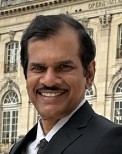
Haleagrahara Nagaraja
- haleagrahara.nagaraja@jcu.edu.au
 https://orcid.org/0000-0001-8702-0490
- Head, Foundation Studies
- General Practice & Rural Medicine
Contact Details
Biography
Nagaraja Haleagrahara, PhD, Graduate Certificate in Education (Academic Practice), Fellow of the Royal Society of Biology (FRSB), is an Associate Professor and Head of Foundation Studies at the College of Medicine and Dentistry, James Cook University. With a Master's and PhD in medical physiology, his research investigates the molecular mechanisms and novel therapeutics of human disease, principally rheumatoid arthritis, neurodegenerative disease and diabetes. His work comprises over 100 peer-reviewed publications, more than 3,770 citations, an h-index of 35 and an i10-index of 60, and a Field-Weighted Citation Impact (FWCI) of 1.30. His research is cited by 11 international patents across six patent families and six national patent offices, and in government policy documentation, evidencing translational reach well beyond the academic literature.
He established and leads a rheumatoid-arthritis research theme at the Australian Institute of Tropical Health and Medicine (AITHM), investigating naturally derived proteins, from hookworms and venom, as anti-inflammatory therapies for arthritis, including pioneering work on marine venom-derived proteins now advancing toward pre-clinical development. Earlier work identified the anti-inflammatory potential of flavonoids in arthritis and the neuroprotective effects of tocotrienols in Parkinson's disease. He currently leads a national competitive research-grant application to scale the arthritis program, and actively builds research capacity by mentoring postdoctoral and early-career researchers to lead their own funded projects. His research has been cited in numerous international textbooks, scholarly handbooks and major reference works from leading academic publishers, reflecting its sustained scholarly influence.
Nagaraja is a nationally recognised medical educator. Over more than 35 years across India, Malaysia and Australia he has transformed the teaching of foundation physiology and pathophysiology through active, blended and case-based learning, and has led major curriculum, assessment and multi-site delivery reform, including establishing the medical program's foundation years at a second campus, introducing online assessment, and leading the shift to online examinations. His teaching leadership has been recognised with the Australian Medical Students Association (AMSA) National Teaching Award, 2025 University Citations for Outstanding Contributions to Student Learning, a 2025 Inclusive Practice Award, selection as a Finalist for a 2025 University Award for Excellence in Leadership, and multiple Dean's Teaching Awards. He has supervised numerous Honours, Masters and PhD students to completion and mentors academic colleagues and students within an inclusive, supportive culture. As Head of Foundation Studies he leads a team of educators across two campuses and represents the University on the national Medical Education Collaborative Committee of the peak body for medical schools. His broader standing includes editorial board membership and guest special-issue editorship for international peer-reviewed journals, grant reviewing for international research funding agencies, external research-thesis examining for universities in Australia, Malaysia and India, and advisory and visiting-professor appointments at universities in India and Sri Lanka. He is a Fellow of the Royal Society of Biology, and sustains international research partnerships across Malaysia, Papua New Guinea and the Indo-Pacific. His interdisciplinary, globally minded approach advances the University's mission of impactful education and research for the tropics and beyond.
Proven Expert Capabilities:
National leadership in medical education – recognised nationally, including the Australian Medical Students Association's National Teaching Award, for sustained teaching and curriculum leadership in the foundation years of the medical program.
Transformative curriculum and assessment design – active, blended and case-based redesign of core foundation modules; introduced online assessment; consistently high student satisfaction above institutional averages.
Distributed, multi-site program leadership – a leading role in establishing the foundation medical program at a second campus, widening access and strengthening the regional medical-workforce pipeline.
Inclusive education and student success – mentoring and transition initiatives supporting international, Indigenous, rural and first-in-family students; recognised with an Inclusive Practice Award.
Educational innovation with emerging technologies – embedding generative AI, immersive virtual reality and assessment integrity in medical education, underpinned by scholarship of teaching and learning.
Translational health research – hookworm and venom-derived proteins as novel anti-inflammatory therapies for rheumatoid arthritis, progressing toward pre-clinical development.
Research that generates impact and income – foundational science that has enabled substantial competitive and philanthropic funding and consolidated a distinctive arthritis research theme.
Sustained research productivity and translational reach – 100+ publications, 3,770+ citations, an h-index of 35, a Field-Weighted Citation Impact of 1.30, and research cited by 11 international patents and by government policy documents.
Scholarly influence in the field – research cited in international textbooks, scholarly handbooks and major reference works from leading academic publishers (including Springer, CRC Press, Routledge, Wiley-Blackwell and the Royal Society of Chemistry).
HDR supervision and research capacity building – numerous Honours, Masters and PhD completions, and mentoring of postdoctoral and early-career researchers to lead their own funded projects.
Collaborative and international partnerships – sustained research partnerships across Malaysia, India, Papua New Guinea and Australian universities; visiting and advisory appointments at universities in India and Sri Lanka.
Intellectual leadership and esteem – editorial board and guest special-issue editorship for international journals; grant reviewing for international agencies; representing the University on the national Medical Education Collaborative Committee; Fellowship of the Royal Society of Biology.
Academic leadership and team development – building and mentoring high-performing teaching teams and supporting colleagues' career progression.
Research
Research Interests
Novel anti-inflammatory protein therapeutics for rheumatoid arthritis — hookworm secretory proteins and venom-derived proteins (box jellyfish and bee venom)
Immunotherapy and inflammatory pathways in rheumatoid arthritis; bioflavonoids (quercetin) and collagen-induced arthritis
Neuroprotection in Parkinson's disease — tocotrienols/vitamin E and palm phytonutrients against oxidative-stress-induced dopaminergic neuronal dysfunction
Diabetes and diabetic foot ulcer — biomarkers, growth factors, and extracorporeal shockwave / electromagnetic stimulation therapies
Oxidative stress and antioxidants in chronic inflammatory disease; Medical-education research — generative AI, immersive virtual reality, assessment integrity and blended learning
Projects
Research Collaborators and Partners
Teaching
Teaching Interests
Physiology, Pathophysiology, Endocrinology, Neurophysiology, Haematology and Renal Physiology
Learning styles and approaches of undergraduate medical students
Generative artificial intelligence in medical education — student use for learning and assessment, and implications for assessment integrity
Immersive virtual reality in foundation medical teaching — feasibility, student perceptions and knowledge acquisition
Evaluating the impact of an integrated blended e-learning program on learning delivery and enhancement in medical education
Evaluating the impact of mobile integrated learning resources on medical student learning outcomes
Multi-site and distributed medical education — designing equivalent learning experiences across campuses
Research Advisor Accreditation
Advisor Type
Primary