
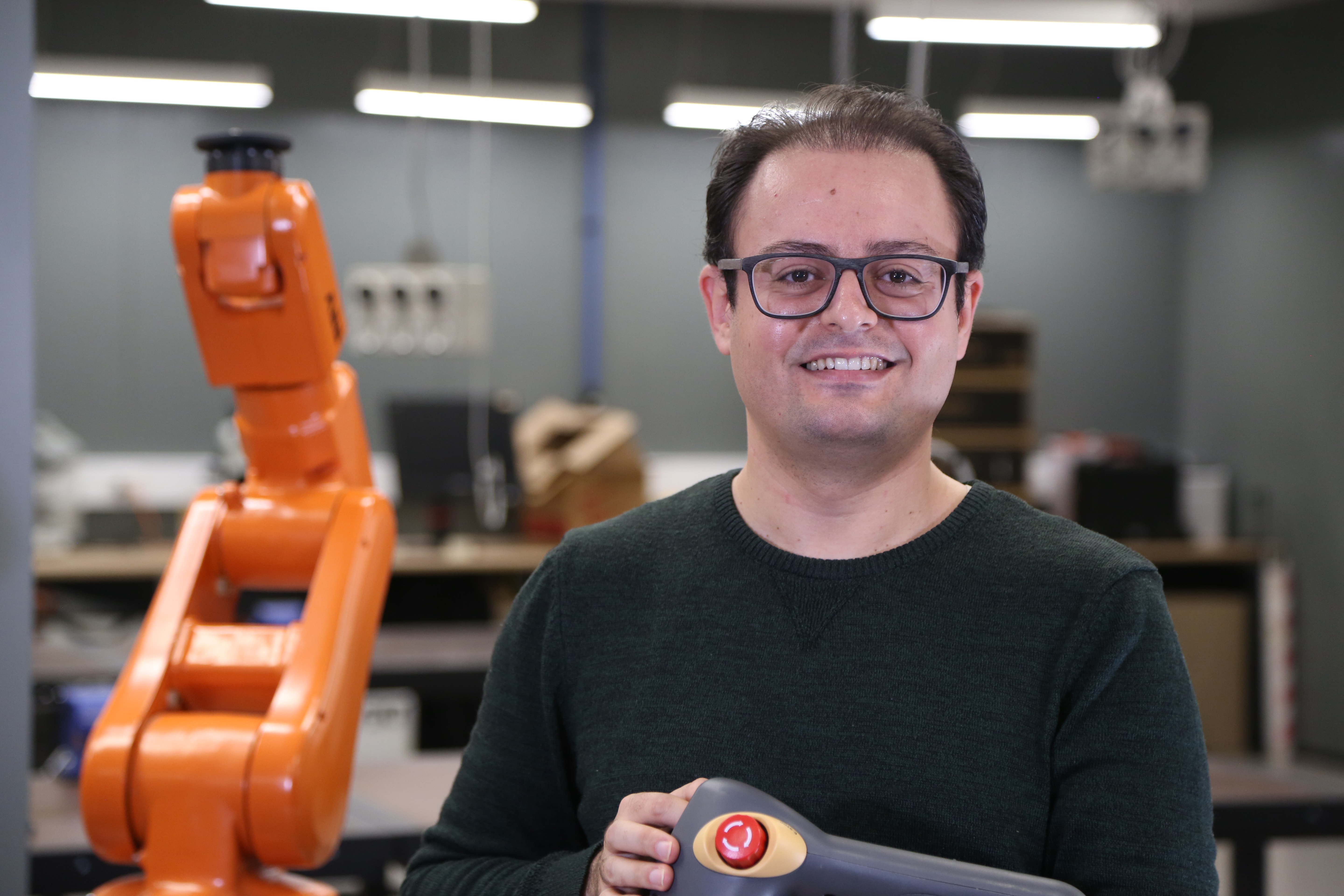
Mohamadreza Chalak Qazani
- mohamadreza.chalakqazani@jcu.edu.au
 https://orcid.org/0000-0003-1839-029X
- Lecturer, Mechanical Engineering
- Engineering
Biography
Dr Mohammad Reza Chalak Qazani is a highly accomplished academic and researcher who has been in academia since 2015. He received his Bachelor of Engineering in Manufacturing and Production from the University of Tabriz, Iran (2010), and his Master’s degree in Robotics and Mechanical Engineering from Tarbiat Modares University, Tehran (2013). His PhD in Modelling and Simulation of Motion Cueing Algorithms using Prediction and Computational Intelligence Techniques from the Institute for Intelligent Systems Research and Innovation (IISRI), Deakin University, Australia (2021).
He has taught at several universities, including Sohar University and Deakin University. He has extensive teaching experience in programming, systems analysis and design, artificial intelligence, advanced programming, data structures and algorithms, as well as mechanical and mechatronic engineering subjects. At James Cook University, he teaches in the Department of Mechanical Engineering, with a focus on design, dynamics, advanced manufacturing, robotics, and computational intelligence applications in engineering.
Dr Qazani has authored over 105 peer-reviewed journal and conference publications, including high-impact papers in leading venues such as IEEE Transactions on Systems, Man, and Cybernetics, IEEE Transactions on Intelligent Transportation Systems, IEEE Transactions on Vehicular Technology, IEEE Transactions on Intelligent Vehicles, IEEE Transactions on Aerospace and Electronic Systems, and Engineering Applications of Artificial Intelligence. He has also presented at flagship IEEE conferences, including FUZZ-IEEE, CEC, and SMC.
His research expertise spans intelligent systems, robotics, motion simulation, model predictive control, and advanced manufacturing, with a strong track record of international collaboration. He has co-authored publications with the German Aerospace Centre (DLR) and completed an industry internship with Cingulan Space (Australia), where he developed path-tracking algorithms for industrial robots to simulate satellite motion. His industrial experience also includes roles in the coating industry, automobile manufacturing, oil and gas, and aerospace sectors.
He has received prestigious recognitions, including the Vice-Chancellor’s Research Fellowship at Deakin University, and has served as Associate Editor for Frontiers in Human Neuroscience and Guest Editor for Axioms (MDPI). He was Chair and Co-Chair for sessions at IEEE SMC 2021 in Melbourne and has supervised PhD students in areas including motion cueing algorithms and physiological data analysis.
Dr Qazani continues to contribute to advancing mechanical and mechatronic engineering research, with a particular focus on integrating artificial intelligence and control theory to enhance the reliability, performance, and safety of engineering systems. His work bridges academia and industry, and he remains committed to training the next generation of engineers and researchers at James Cook University.
Research
Research Interests
- Intelligent Control Systems: Model Predictive Control (MPC), nonlinear and adaptive control, stability analysis, and real-time optimisation.
- Robotics and Mechatronics: Motion cueing algorithms, human-in-the-loop simulation, parallel and serial manipulators, and autonomous vehicle systems.
- Artificial Intelligence in Engineering: Machine learning, deep learning, fuzzy logic, optimisation algorithms, and physics-informed neural networks applied to mechanical and mechatronic systems.
- Advanced Manufacturing: CNC machining, sustainable manufacturing, additive manufacturing optimisation, and industrial Internet of Things (IIoT) applications.
- Sustainable Energy Systems: Wind and solar forecasting, microbial fuel cells, nanofluids for heat transfer, and optimisation of renewable energy technologies.
- Human–Machine Interaction: Motion simulators, driver customisation, haptics-enabled systems, and brain–computer interfaces for control and rehabilitation.
- Computational Methods: Soft computing, meta-heuristic algorithms, statistics, data analysis, and multi-objective optimisation.
Research Collaborators and Partners
Teaching
Teaching Interests
Course Design and Learning Outcomes Development
In my teaching practice, I place significant emphasis on designing courses that are aligned with institutional standards and student needs. I develop course profiles from the ground up, beginning with a thorough review of the subject matter and student expectations. I incorporate Bloom’s Taxonomy into the design of SLOs to ensure progression from lower-order cognitive skills (knowledge and comprehension) to higher-order skills (analysis, synthesis, and evaluation). This structure ensures that students are equipped to engage in critical and practical applications of their learning. For example, in a recent software engineering course, I developed SLOs that required students not only to "understand" key design principles but also to "apply" them to solve real-world problems and, ultimately, to "evaluate" the effectiveness of their solutions. This progression allows students to deepen their understanding of the subject while developing essential skills for their professional futures.
Inclusive Teaching Methods and Learning Styles
Recognising that students have diverse learning preferences, I adopt an inclusive approach by utilising a range of teaching strategies that cater to all types of learners. My course materials and instructional techniques are designed to engage visual, auditory, and kinesthetic learners, as well as those who excel in individual (solo) or group-based (social) learning environments. By incorporating multimedia presentations, discussions, hands-on activities, and collaborative group work, I create a learning environment that accommodates every student’s learning style. One of the methods I use to promote inclusivity is offering multiple forms of engagement, including interactive discussions, case studies, simulations, and self-paced learning modules. This holistic approach ensures that students are actively engaged regardless of their preferred learning methods.
Evidence-Based Teaching and Active Learning Models
I integrate evidence-based teaching methods into my courses to enhance student engagement and learning outcomes. One of the key models I employ is the flipped classroom, in which students are introduced to course material outside the classroom through readings, videos, or assignments. Class time is then devoted to in-depth discussions, practical exercises, and collaborative problem-solving activities. This model encourages active learning and enables students to take ownership of their education. In addition, I have incorporated formative assessments, such as weekly or fortnightly quizzes, into my courses. These quizzes serve as checkpoints for students to assess their understanding of the material and for me to adjust my teaching strategies as needed. This regular feedback loop helps reinforce student learning and provides me with real-time insights into their progress.
Professional Development and Fellowship
In my ongoing commitment to improving my teaching practice, I have completed a short (10-session) training course by Advance Higher Education (Advance HE). Through this course, I used the senior fellowship framework to develop and implement advanced teaching methods in my courses at Sohar University. Additionally, I have applied for an Associate Fellowship from Advance HE and am currently awaiting my university's approval to pay for it. These experiences have significantly enhanced my ability to design and deliver high-quality, student-centred instruction.
Feedback and Assessment
Student feedback plays a pivotal role in shaping my teaching methods. Throughout the semester, I collect feedback to ensure that I am meeting the evolving needs of my students. I believe that a responsive teaching style is essential to fostering an environment of continuous improvement. Moreover, my approach to assessment is comprehensive and aligned with the SLOs. I utilise various assessment tools, including quizzes, projects, and final exams, to measure both student progress and success. By mapping final marks to the SLOs, I ensure that assessments reflect not only knowledge acquisition but also the ability to apply that knowledge in practical contexts. This approach enables a more accurate evaluation of student success and areas requiring further development.